24
What does a pilot built around a ticking clock actually do in its first hour? And why did audiences keep showing up at the same time every single week?

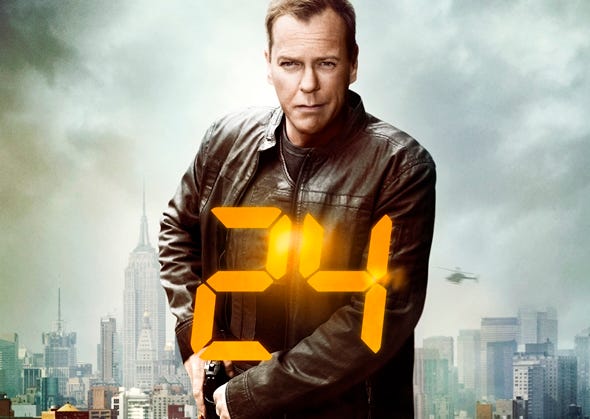
Last time out I put the Stranger Things pilot through my script analysis tool and walked through what its structure quietly revealed beneath the surface. A few of you wrote back asking what other pilots would look like under the same lens, and one title kept surfacing. So here we are. Today I want to talk about 24.
A quick reminder for anyone new here. For the better part of a year I have been building a tool that reads movie and TV scripts and breaks them down in an organized, repeatable way. It runs on large language models, but I have programmed it strictly to read and analyze rather than to learn or generate. The goal is simple. Give writers, producers, and business development people a shared analytical foundation, a common language they can actually agree on when they sit down to argue about what a script is doing and why. I am aiming to make it commercially available in August. Until then I am sharing what I find here, in public, while it is still being built.
And I will be honest about why I reached for 24.
When I wrote about Stranger Things, I spent a fair amount of time on the retention problem facing streaming services. The core issue is cadence, or rather the loss of it. When everything is available all at once and the slate never stops expanding, audiences have no structural reason to commit to any one show over time. They chase whatever is hot this week and then move on to the next thing.
24 is fascinating to me precisely because it comes from the opposite world and solved the opposite problem in the most literal way imaginable. It premiered on Fox on November 6, 2001, deep in the age of appointment television, when a network needed you to show up at a specific hour on a specific night or you simply missed the episode. And 24 took that constraint and made it the entire premise of the show. Each season covers a single day. Each episode covers a single hour of that day, told in something very close to real time, with a digital clock ticking on screen and a split screen pushing several storylines forward at once. The form itself was a retention mechanism. You could not skip ahead without breaking the pact, because the pact was the clock.
I find that genuinely remarkable as a piece of media engineering. Most shows try to earn your return through character and mystery, the softer debts I wrote about last time. 24 did that too, and did it well. But it also wired your return directly into the structure of the thing. The clock is a promise and a threat at the same time. Tune in next week, same hour, or the hour happens without you.
There is also the matter of timing, and I do not mean the one on screen. 24 arrived less than two months after the September 11th attacks, and a show about a counterterrorism agent racing the clock to stop a plot landed in a country that was suddenly, painfully primed to receive it. I am going to set aside the long and legitimately fraught conversation about how the series handled torture and politics across its full run, because that deserves its own piece and is not really what the pilot is doing. But it would be dishonest to analyze this episode as a pure structural object and pretend the cultural moment had nothing to do with why it worked.
So that is the setup. Below I want to walk through what the first hour of 24 actually does, what the tool surfaced when I ran the script through it, and why I think this pilot holds up as one of the more confident opening hours network television has produced. For what it is worth, it won the Emmy for Outstanding Writing for a Drama Series, so the people who hand out trophies agreed.
As always, I am eager for feedback. I am still figuring out how to make these breakdowns clearer and more useful for the people who actually make this stuff. Find me on LinkedIn at https://www.linkedin.com/in/aphd/. Happy to chat.
Moving on.
What the First Hour Actually Did
The pilot was working with a structural problem that is, in its own way, as constrained as the Stranger Things premise. You have sixty minutes of story that has to occupy sixty minutes of clock. You cannot cut to three weeks later. You cannot montage your way past the boring parts. Every minute you spend is a minute the audience spends with you, and the meter is running the whole time. That sounds like a cage. The Duffer Brothers earned their tension through restraint and silence. Robert Cochran and Joel Surnow earned theirs through a different bet entirely, and a few things became clear once I ran it through the tool.
First, the pilot establishes simultaneity before it establishes plot. The episode opens in Kuala Lumpur, in the shadow of the Petronas Towers, with a spy named Victor Rovner sending a message halfway around the world. Within minutes we are in Los Angeles with Jack Bauer and his family, then inside the Counter Terrorist Unit, then on the move with a presidential campaign. The show is not easing you into a single storyline. It is teaching you, immediately and without apology, that you are going to be holding several places at once and that they are all happening right now, in parallel. The split screen is not a stylistic flourish. It is the grammar of the entire show, introduced in the first hour so the audience learns the rules early.
Second, the pilot fuses the personal and the professional and refuses to let you separate them. Jack is called in because there is a credible threat on the life of Senator David Palmer, a leading presidential candidate, on the day of the California primary. At the very same moment his teenage daughter Kim has climbed out her bedroom window, and his wife Teri is trying to find her, in a marriage that the episode tells us is already strained and recently fractured. A lesser pilot would treat the domestic thread as relief from the political one. 24 does the opposite. It builds toward the realization that the two worlds are the same world, that the people coming for Palmer understand exactly who Jack loves and exactly how to use them. The stakes at CTU and the stakes in Jack’s own home are not running on separate tracks. They are the same track, and the pilot lays the rail for that collision in its opening hour.
Third, and this is where I think the pilot earns its reputation, it makes a deliberate bet on the audience’s tolerance for not knowing. There may be a mole inside CTU. Palmer receives a phone call that visibly unsettles him, and we are given almost nothing about who is on the other end. The full shape of the plot against him stays offstage. Like the best pilots, 24 treats those gaps as promises rather than as problems to be patched over with exposition. It trusts that a viewer who is denied an answer at midnight will come back at the same hour next week to get one.

The study analyzed nearly every episode of 24 by breaking each script into its three acts and measuring dialogue features at each stage, including things like analytical language density, emotional register, and how much the characters said. The goal was to see which of those features, in which act, predicted how many people watched the following week’s episode.
Think of it as asking: if you could read the script before the episode aired, what would tell you whether viewers were going to come back?
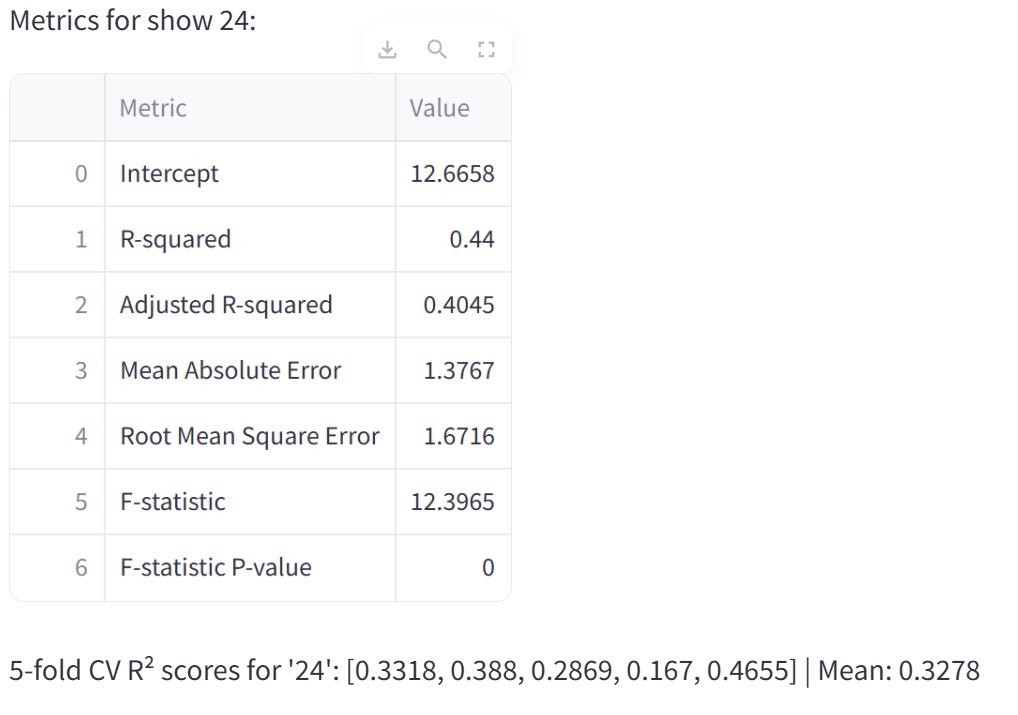
40.45% Variance explained (Adjusted R²) — in-sample model fit
32.78% Out-of-sample fit tested on unseen episodes
CV folds 0.33/ 0.39 / 0.29 / 0.17 / 0.47
192 of 195 episodes analyzed — near-complete series corpus (98.5%)
When we tested the model on episodes it had never seen before, it explained about 40.45% of the variation in viewership from one week to the next, from dialogue features alone, with no information about scheduling, marketing, or what was on the other channel. That’s a meaningful signal from something as seemingly mechanical as word choice. While the dependent variable is next-episode viewership in millions, I don’t believe the coefficients that you are about to see impact millions of viewers directly, as there are far too many other forces not captured in the model. But directionally, I believe that my database helps decode why particular TV series work based on character dialogue.
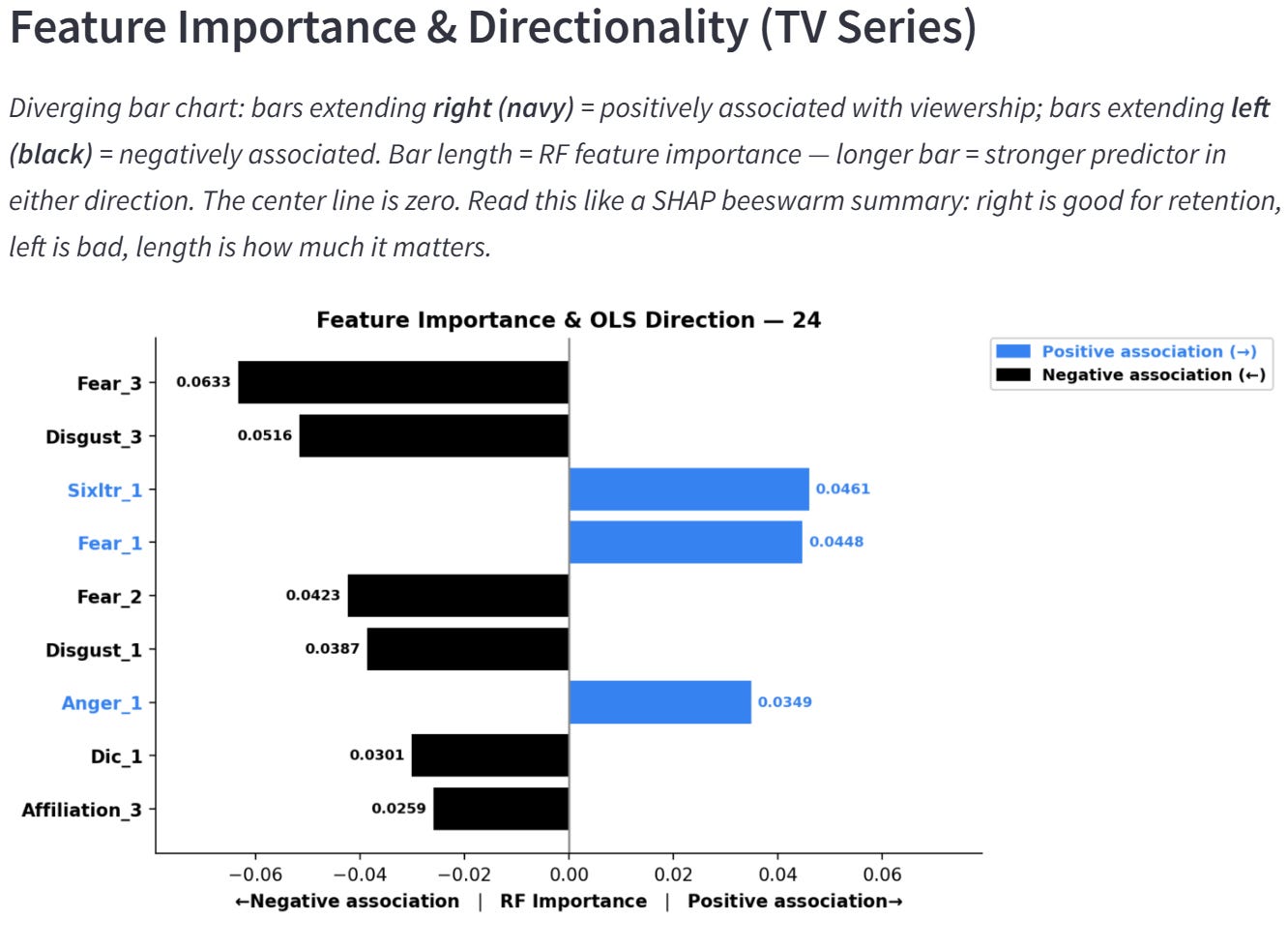
Seven features turned out to be statistically significant predictors. Here’s what they were, what they mean in plain English, and which episodes make the pattern obvious.
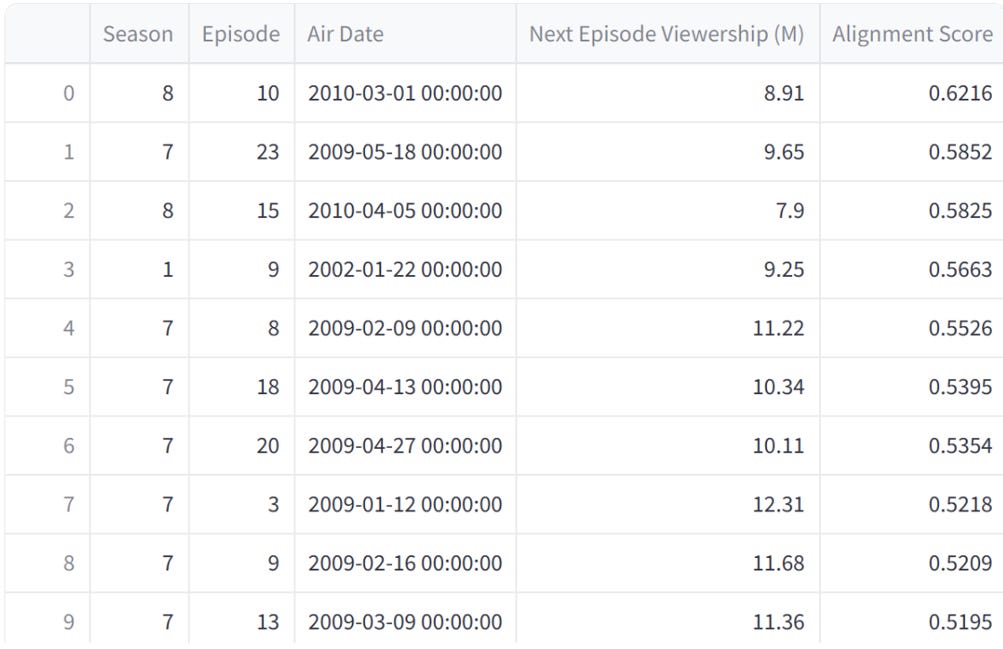
What Helped: The Features That Brought Viewers Back
1. Sophisticated vocabulary in the opening act (Sixltr_1)
The strongest positive predictor in the entire model was the share of long words, words over six letters, in Act 1. The coefficient: +2.20.
This one runs directly against the conventional wisdom about cold opens, which says keep it simple, keep it visceral, do not make the audience work before you have earned their attention. 24 says the opposite, and the reason is structural rather than stylistic. Long words in the opening act of this show are not ornamental. They are the sound of expertise. Protocols, jurisdictions, intelligence assessments, the names of foreign capitals and government agencies and the people who run them. When the first act of a 24 hour is lexically dense, it is telling the audience that the world they are entering is real, intricate, and consequential. The density is the stakes.
A thriller that opens in plain, common language is a thriller that sounds like it could happen anywhere, to anyone, over nothing in particular. A thriller that opens in the specialized vocabulary of counterterrorism sounds like it could only happen here, and only now, and only to people who know what they are doing. The audience leans in not because the words are hard but because the difficulty signals that something important is underway.
Episode in focus · Season 8, Episode 10 · “Day 8: 1:00 a.m.-2:00 a.m.” · Alignment score: 0.6216
This is the most aligned episode in the data I am looking at, and its opening register is a clean demonstration of why. President Taylor is leaning on President Hassan, Kayla has gone missing, a New Jersey swamp gives up two bodies, and Jack is constructing a ruse to draw out the Kamistani rebels. Read that sentence again and notice how much of it is proper nouns and procedural machinery. The hour opens inside a dense lattice of diplomatic names, fictional geography, and operational planning, and the lexical weight of all that is exactly what the Sixltr_1 coefficient of +2.20 is rewarding. The episode sounds expert from its first minutes, and the model says that is part of why audiences stayed.
2. Anger in the opening act (Anger_1)
The second positive predictor is anger in Act 1. The coefficient: +1.59.
If sophisticated vocabulary is what makes the opening act feel real, anger is what makes it feel urgent. 24 is a show whose entire premise is a day going wrong, and the first act is where the wrongness announces itself. Hostility, confrontation, the threat made explicit, the alliance fracturing. Anger in the opening act is the ignition. It is the moment the clock starts to matter.
The instinct to read this as a warning, to file anger under things that alienate an audience, gets the genre backward. In a sitcom, opening in anger might cost you the warmth the form depends on. In a real time thriller, anger is the genre contract. The audience tuned in precisely because they expect the day to detonate, and a first act that delivers that conflict is a first act that confirms the bargain. The danger is not too much anger early. The danger, as we are about to see, is the wrong emotion late.
Episode in focus · Season 7, Episode 8 · “Day 7: 3:00 p.m.-4:00 p.m.” · Alignment score: 0.5526
I will not pretend to a tidy logline for this specific hour, but it sits in the heart of the Season 7 arc, the stretch where an exiled Jack is pulled back in to chase Iké Dubaku and his conspiracy while the betrayal of a former ally tightens in the background. That is a season built on antagonism and broken trust, and this hour carries the highest next episode viewership in the entire dataset at 11.22 million. An episode that opens in that register of confrontation, and then hands the audience an 11 million viewer return, is the Anger_1 coefficient made visible.
What Hurt: The Features That Drove Viewers Away
3. Generic vocabulary in the opening act (Dic_1)
The mirror image of finding number one. Episodes whose Act 1 dialogue scored higher on dictionary density, a larger share of words drawn from common vocabulary, predicted fewer viewers the following week. The coefficient: −1.59.
Sixltr_1 and Dic_1 are two readings of the same dial. When the opening act reaches for sophisticated, specific language, retention rises. When it settles into ordinary, common words, retention falls. Generic vocabulary is the register of generic stakes. If the first act of a 24 hour could have been spoken on any procedural on television, then it is not yet the opening of this show. It is the opening of a category. The audience came for CTU, and an opening act that sounds like any control room is an opening act that has not yet earned the clock.
4. Disgust in the opening act (Disgust_1)
Episodes whose Act 1 dialogue scored higher on disgust, the language of revulsion, moral violation, and the transgression of norms, predicted fewer viewers the following week. The coefficient: −1.72.
24 promises competence under pressure, the satisfaction of watching capable people impose order on chaos against a ticking clock. Revulsion does not serve that promise. It stalls it. An opening act soaked in moral nausea asks the audience to recoil at the exact moment the show needs them to lean forward. The same lexical signal, two genres, opposite signs. That is not noise. That is the genre contract showing up in the data.
5. Bonding language in the closing act (Affiliation_3)
Episodes whose Act 3 dialogue scored higher on affiliation, the language of social bonds, alliance, and friendship, predicted fewer viewers the following week. The coefficient: −1.34.
Here the model starts describing the back of the episode, and a clear rule emerges: the closing act of 24 is for propulsion, not for reunion. Affiliation language in Act 3 tends to mark an hour that is winding down emotionally, settling its characters into connection and resolution. That is the wrong motion for this show. A 24 hour does not end. It hands off. The closing act is a launchpad for the next one, and the bargain that keeps audiences returning is the promise that the danger is not over, that someone is compromised, that the clock has merely reset toward the next crisis. When the final act turns toward the warmth of bonds rather than the tension of what comes next, it spends the very momentum the cliffhanger is supposed to carry forward.
6. Fear in the closing act (Fear_3)
Episodes whose Act 3 dialogue scored higher on fear, the language of dread, threat, and apprehension, predicted fewer viewers the following week. The coefficient: −2.01.
This is the counterintuitive heart of the whole analysis. 24 is a show that traffics in dread. It is, on its surface, an hour by hour machine for generating fear. And yet fear in the closing act is one of the largest penalties in the model. How?
The answer is in the difference between fear and propulsion. A closing act that tilts into fear is a closing act that leaves the audience in apprehension, in the felt sense of threat without agency, in dread that has nowhere to go. That is not the engine of this show. The engine is Jack acting. The cliffhanger that brings an audience back is not “something terrible is going to happen and we are helpless.” It is “something terrible is happening and watch what he does about it.” Fear that ends in paralysis breaks the contract. The clock demands forward motion, and a final act that ends in pure dread is a final act that has stopped the clock at the worst possible moment.
7. Disgust in the closing act (Disgust_3)
And the largest penalty in the entire model: disgust in Act 3, the language of revulsion and moral violation arriving at the climax. The coefficient: −2.58.
Everything that made Disgust_1 corrosive is amplified here, because the closing act is where the audience decides whether to come back. Disgust in the opening act stalls the engine. Disgust in the closing act poisons the handoff. An hour that leaves its audience revolted rather than propelled is an hour that has converted its final, most important real estate into a reason to look away. For a show whose closing act is supposed to be a coiled spring pointing at next week, ending in moral nausea is the surest single way to lose the audience the clock was built to keep.
Episode Deep-Dives
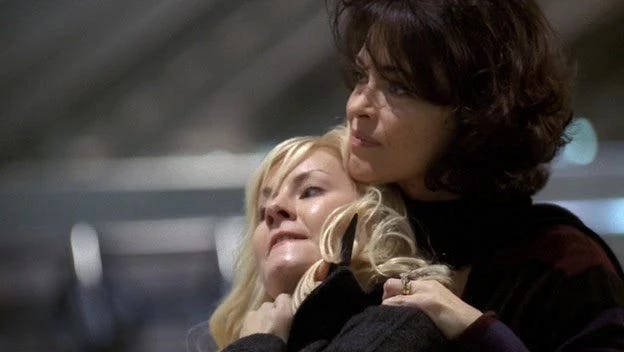
Episode in focus · Season 7, Episode 23 · “Day 7: 6:00 a.m.-7:00 a.m.” · Alignment score: 0.5852
Jack is abducted for unknown purposes, Kim sits in danger at the airport, and Olivia matches wits with Ethan Kanin. This is the penultimate hour of the season, and you can feel the apprehension loading into its close. It is a deeply aligned episode, 0.5852, and it still drew a strong 9.64 million the following week, so I am not arguing it failed. I am arguing it paid a cost the model can see. The Fear_3 penalty of −2.01 is the tax on an hour whose closing register leans toward peril and helplessness rather than the propulsive, what does Jack do next motion that defines the show at its most retentive.

Episode in focus · Season 8, Episode 15 · “Day 8: 6:00 a.m.-7:00 a.m.” · Alignment score: 0.5825
Season 8 is where the show darkens, where Jack moves toward the increasingly grim and personal war that defines its final stretch. That darkening register is exactly the territory where the Disgust_3 penalty bites. This hour is highly aligned at 0.5825, structurally typical of late 24, and it carries a real cost in the model precisely because of how far the season’s tone has drifted toward the bleak. The next episode viewership of 7.9 million is the lowest among the most aligned hours in the data, which is the kind of quiet corroboration the −2.58 coefficient would predict.
One More Wrinkle: What the Thriller Genre Says
Step back from the individual coefficients and a single shape emerges. The model is describing where each kind of energy belongs in a 24 hour, and the rule is almost architectural.
The front of the hour wants density and heat. Sophisticated, specific vocabulary and open conflict are the two strongest positive signals in the opening act, and they do complementary work. The density establishes that the world is real and the stakes are serious. The anger establishes that the day has already gone wrong. Together they are the ignition, and the model rewards an opening that fires on both.
The back of the hour wants propulsion, and almost nothing else. Every Act 3 signal in the model is a penalty. Fear, disgust, and the warmth of bonding all drag the closing act in the wrong direction, because the closing act of a 24 hour has exactly one job: to point at next week with enough force that the audience cannot look away. Dread that ends in helplessness, revulsion that ends in nausea, and sentiment that ends in reunion all spend the momentum the cliffhanger is built to carry. The clock does not stop at the end of the hour. It hands off, and the handoff is the whole game.
Everything the model rewards or penalizes comes down to a single structural truth, which is that a real time thriller lives or dies on whether it launches the next hour rather than on whether it explains the current one. The opening of a 24 hour earns the hour you are watching, while the closing act earns the one you will return for, and that is why the show is rewarded for the density and conflict that ignite an episode and penalized for the fear, disgust, and sentiment that would let it coast quietly to a stop. Read in that light, the model is less a scorecard than a map of how 24 keeps its clock running, hour after hour and week after week.
So What Would You Actually Change? The Writer’s Takeaway
The point is not to write a more frightening show, which would be both obvious and, per the data, counterproductive. The implications are more specific, and more useful.
Positive relationships, consider emphasizing
+2.20 · Sophisticated vocabulary in Act 1. Let the opening sound expert. The procedural and geopolitical density that makes the world feel real is doing retention work, not getting in its way. → If your cold open has been simplified for accessibility, ask whether you have sanded off the authority that made it feel high stakes.
+1.59 · Anger in Act 1. Open in conflict. A first act with antagonism, threat, and confrontation starts the clock the audience came to watch. → If your opening act is still arranging furniture by minute ten, the day has not gone wrong yet, and the day going wrong is the show.
Negative relationships, use with caution
−1.59 · Generic vocabulary in Act 1. Common language signals common stakes. → If your opening act could be spoken on any control room set on television, it is not yet the opening of this show.
−1.72 · Disgust in Act 1. Do not open in revulsion. Moral nausea stalls the engine before it starts. → A thriller can feel like the natural home for the transgressive, but in the opening act it reads as friction. Save the recoil.
−1.34 · Affiliation in Act 3. Hold the bonding. The closing act is a launchpad, not a reunion. → If your final act turns toward warmth and connection, you have spent the momentum the cliffhanger needed.
−2.01 · Fear in Act 3. End in motion, not dread. The climax should propel, not paralyze. → Fear that ends in helplessness is not the same as a threat that ends in “watch what he does next.” Only the second one brings them back.
−2.58 · Disgust in Act 3. The largest penalty in the model. Do not end in revulsion. → A final act that leaves the audience nauseated rather than propelled is the surest single way to lose next week.
Technical Notes & Full Output
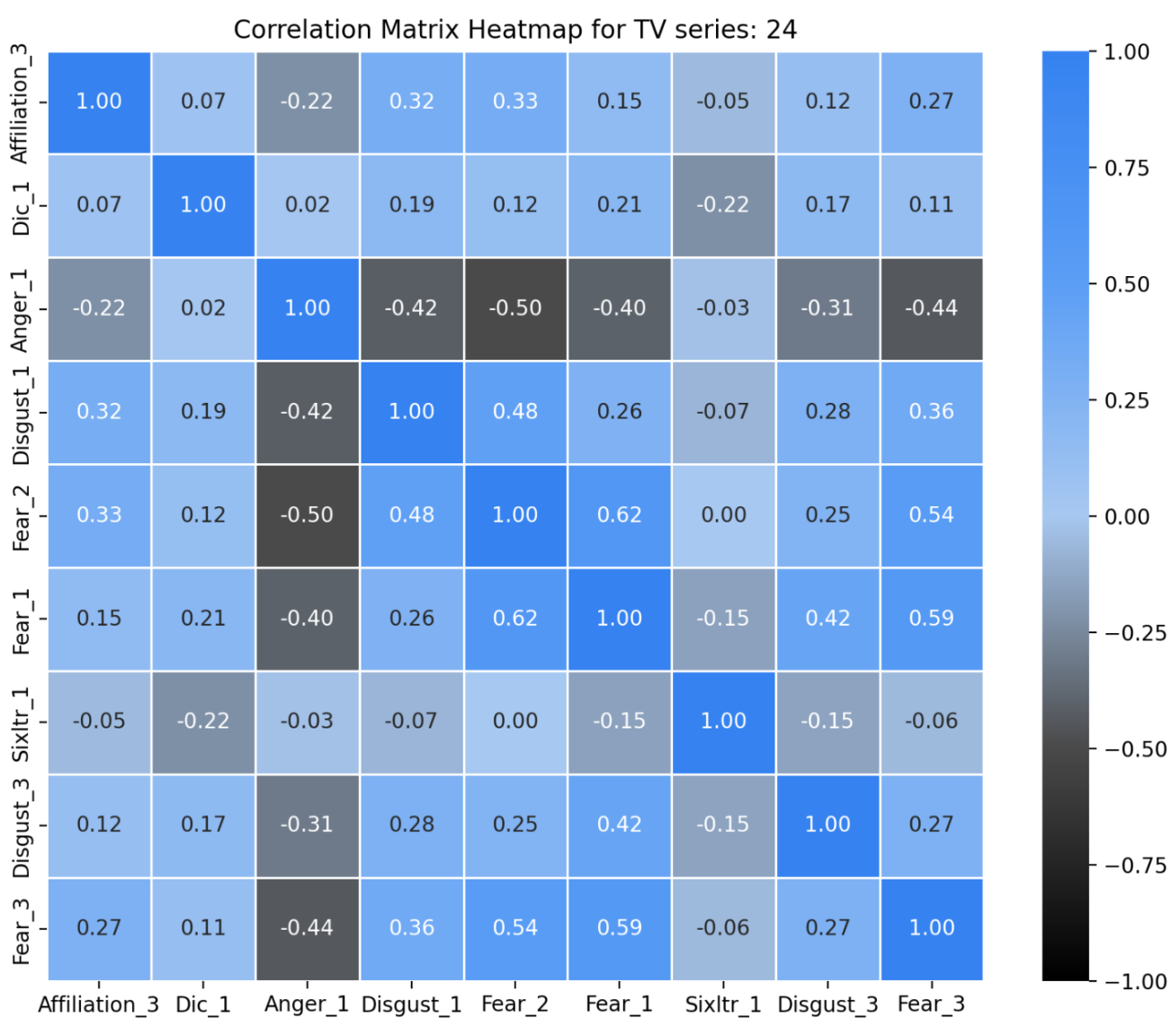
Appendix A · Glossary of All Seven Measures
Each feature was extracted using LIWC (Linguistic Inquiry and Word Count) and related computational text analysis tools, applied at the act level. The suffix _1, _2, or _3 denotes the act in which the feature was measured.
Significant positive predictors, more of this, more viewers next week
Sixltr_1 · Words over six letters, Act 1. Proportion of opening act words longer than six letters. Captures lexical density and a register of expertise and specificity, the sound of a world worth taking seriously. sig. positive · coef +2.20
Anger_1 · Anger language, Act 1. LIWC Anger category in the opening act: proportion of words associated with hostility, aggression, and confrontation. Captures the conflict that ignites the episode’s clock. sig. positive · coef +1.59
Significant negative predictors, more of this, fewer viewers next week
Dic_1 · Dictionary density, Act 1. Percentage of opening act words drawn from common vocabulary. High scores indicate a generic opening register, language that could belong to any procedural. sig. negative · coef −1.59
Disgust_1 · Disgust language, Act 1. LIWC Disgust category in the opening act: words of revulsion, moral violation, and transgression. Corrosive in a show whose promise is competence, not discomfort. sig. negative · coef −1.72
Affiliation_3 · Affiliation language, Act 3. LIWC Affiliation category in the closing act: words associated with social bonds, alliance, and friendship. Captures a climax that turns toward connection rather than propulsion. sig. negative · coef −1.34
Fear_3 · Fear language, Act 3. LIWC Fear category in the closing act: words of dread, threat, and apprehension. Captures a climax that ends in helplessness rather than forward motion. sig. negative · coef −2.01
Disgust_3 · Disgust language, Act 3. LIWC Disgust category in the closing act: words of revulsion and moral violation arriving at the climax. The largest penalty in the model. sig. negative · coef −2.58
Appendix B · Most Aligned Episodes
The alignment score measures something specific, and it is worth being precise about what that is: how closely an individual episode’s writing matched the full feature pattern the show level Random Forest identified as predictive of retention. A high alignment score does not mean an episode performed well. It means the writing was operating inside the show’s structural fingerprint, exhibiting the features the model found important, in proportions consistent with what it learned from the corpus.
With that definition in place, here are the most aligned episodes in the data, alongside the viewership of the episode that followed each one.
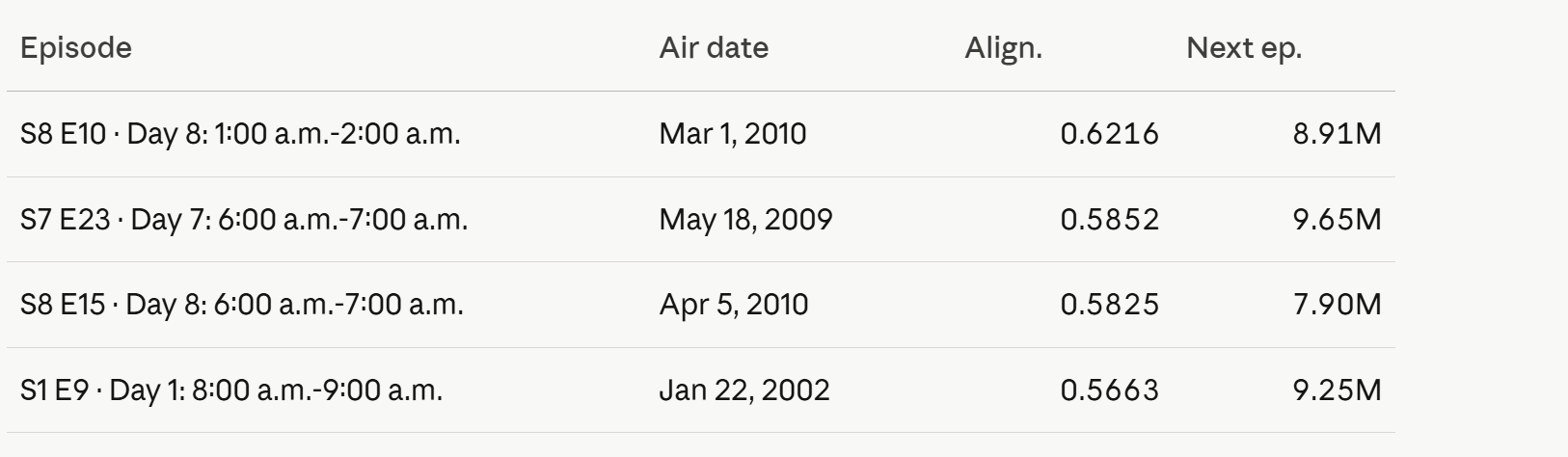
The first thing the table shows is where the most aligned episodes came from. They cluster in Seasons 7 and 8, the show’s late run. The single highest alignment score belongs to a Season 8 hour, and the ranked group is entirely a late seasons affair. The writing was more precisely calibrated to the retention pattern during the show’s later years than at most points earlier in its life.
The second thing the table shows is what that precision was actually worth, and the caution here is one worth stating plainly. Alignment is not performance. The most aligned hour in the data, Season 8 Episode 10 at 0.6216, was followed by 8.91 million viewers. The least aligned hour in the ranked group, Season 7 Episode 8 at 0.5526, was followed by 11.22 million, the strongest return in the entire dataset. The episode that best matched the learned pattern was not the episode that retained the most people. The ceiling moved independently of the fingerprint, which is precisely the gap the alignment score is built to reveal rather than hide.
The third thing the table invites is the question of why late season episodes dominate the very top, and the answer is a two part explanation. The first part is a training artifact. The Random Forest was fit on the full run, so the later seasons make up a meaningful share of the data it learned from. When late season hours score high on alignment, part of what is being measured is that the model recognizes them as structurally typical of the era it was substantially trained on. The second part is variance. Peak era 24 was taking more risks, running wilder plot mechanics, and spreading its episodes further from any central tendency, which produces a wider spread of alignment scores without implying weaker writing. That dispersion is exactly why a Season 1 hour can land at a respectable 0.5663 while other peak era episodes fall well below the group. By the late seasons the show had contracted into a narrower creative range, and less experimentation means more episodes clustering near the model's center of mass, which it reads as high alignment regardless of direction. Consistency is not correctness. The Season 1 hour is a useful reminder of the same point from the other direction: it aligns respectably and was followed by a strong 9.25 million, yet sits below two late season hours that drew fewer viewers the next week. Structural typicality and performance are different axes, and the table refuses to let them collapse into one.
Generalizability. Findings are specific to 24 and should not be applied directly to other series without replication. The emotional predictors in particular appear to be genre conditional rather than universal. What a register like disgust or fear means depends entirely on the promise a show has made to its audience, and 24's promise is a specific one. Cross genre and cross network analysis is ongoing. The vocabulary penalties appear to travel across procedurals. The emotional registers, so far, look more local to the show.